
About the Insight Journal
Our Vision
We envision a world where scientific research earns and maintains public trust through open, transparent, and reliable publishing platforms. The Insight Journal aims to repair and strengthen confidence in medical image analysis research by providing a publication venue that embraces full openness and reproducibility through Decentralized Science (DeSci).
Mission Statement
Enable reproducible scientific image analysis and visualization research by providing an open, interactive, and decentralized platform for publishing manuscripts, data, code, and research artifacts.
Our Values
The Insight Journal is built on three foundational pillars that align with the principles of Decentralized Science (DeSci):
🔓 Open Science
We champion complete openness in research dissemination and validation:
- Open Access: No paywalls or publication charges. All research is freely available to everyone, everywhere, forever.
- Reproducibility: All submissions include data, code, and parameters, enabling complete verification and reuse. Research that cannot be reproduced cannot be verified.
- Transparency: Open peer-review with visible dialogues between reviewers and authors. The review process becomes part of the scientific record, increasing trust and accountability.
- Innovation: Interactive, web-enabled visualizations and modern publishing tools (MyST, ITK-Wasm) transform passive reading into active exploration and enable computational reproducibility.
🌐 Decentralized Infrastructure
We build resilient, community-owned systems free from centralized control:
- Distributed Storage: Content stored across the Interplanetary File System (IPFS) nodes ensures availability even if individual servers fail. Many copies keep things safe.
- Verifiable Provenance: Cryptographic identifiers (DPIDs) and blockchain-based records create tamper-proof provenance for all contributions.
- Community Governance: Decision-making power resides with the community, not corporate publishers. The journal's future belongs to its contributors.
- Sustainability: Built on open-source principles with cost-effective infrastructure designed for long-term preservation and community ownership.
🤝 Community & Incentives
We recognize and reward all contributions to advance scientific progress:
- Contributor Recognition: All contributors—authors, reviewers, data providers— receive formal credit through ORCID integration and attestations.
- Reputation Systems: Quality contributions build verifiable reputation, creating incentives aligned with scientific progress that are recognized and rewarded through Digital Object Identifiers (DOIs).
- Global Collaboration: Open participation regardless of institutional affiliation, geography, or career stage. Merit is measured by contribution, not credentials.
- Fairness & Equity: Equal access to publication and review opportunities, removing barriers that exclude researchers from underrepresented communities.
The Problem with "Publish or Perish"
The current publishing system has inverted priorities. The motto "Publish or Perish" reveals its corruption—note that it does not say "Research or Perish!" This subtle distinction has profound consequences: researchers work "in order to publish" rather than because their work has significant impact on society.
This system forces researchers to embark only on publishable activities, which discourages significant departures from views held by the establishment of experts who serve as journal reviewers. Innovation is stifled; conformity is rewarded.
Publications are counted for career advancement, not evaluated for quality, relevance, or impact. The number of publications in your CV—not their substance—matters when seeking:
- A degree
- A job in industry or academia
- A tenure position in a university
- A promotion
- A grant from federal or state agencies
The Scientific Method
The Scientific Method was introduced by Galileo in the 1500s when he embarked on a series of attempts to answer fundamental questions about physics by performing experiments. Galileo was also at the center of the first scientific journal, published by the "Linceans," also known as the Society of the Lynx. The name derived from the acute vision of this animal, conveying the idea that careful observation of experiments was required for finding truth about scientific matters.

Portrait of Galileo Galilei by Justus Sustermans
The Insight Journal returns to these principles: careful observation, reproducible experiments, and open sharing of methods and results. We seek to support the altruistic motivation of performing scientific research rather than the corrupted imperative to publish for career advancement.
Our Strategy
To establish the Insight Journal as the premier publication venue in scientific and medical image analysis, we aim to:
- Set global standards for openness and interactive scholarship
- Drive progress toward a truly FAIR (Findable, Accessible, Interoperable, Reusable) and transparent research ecosystem
- Build robust community governance
- Catalyze scientific collaboration and nurture innovation
- Transform passive reading into active engagement through interactive visualizations
Sustainable Open Science with Web3 Technology
The Insight Journal 3 (IJ3) is an innovative undertaking to bring sustainability to reproducible research through the power of decentralized Web3 technologies.
The IJ3 is built on a foundation of proven technologies:
- Git: Version control and collaborative development
- InterPlanetary File System (IPFS): Decentralized storage
- Ethereum: Blockchain-based verification and provenance

It's Merkle trees all the way down.
These technologies all share a common foundation: Merkle trees, which provide cryptographic
verification and tamper-proof records. Every change, every version, every contribution is
permanently and verifiably recorded.
Post-publication manipulations are impossible without detection. This ensures integrity, transparency, and trustworthiness
FAIR by Design
The platform's architecture ensures all research objects are:
- Findable: Indexed in OpenAlex, CrossRef, and Google Scholar
- Accessible: Open access with no paywalls or publication charges
- Interoperable: Standards-compliant metadata and identifiers
- Reusable: Open licenses, complete documentation, and included dependencies
Interactive Visualizations with ITK-Wasm and NiiVue
Building on the Insight Toolkit (ITK), the journal supports browser-based visualization of medical imaging datasets through ITK-Wasm and NiiVue. This enables:
- Direct 3D visualization of medical images in web browsers
- Interactive exploration of imaging data without specialized software
- Cross-platform compatibility without installation requirements
DeSci Nodes Platform
The Insight Journal operates on DeSci Nodes, a decentralized science publication platform that enables researchers to publish and share research objects—not just manuscripts, but complete packages of data, code, visualizations, and documentation.
Key Features of DeSci Nodes
- Research Objects: Publish manuscripts alongside data, code, images, and other artifacts in a single, coherent package
- Version Control: Track the evolution of research from initial ideas through publication and beyond
- Persistent Identifiers (DPIDs): Content-addressed identifiers that never break or require maintenance
- Decentralized Storage: Content stored across multiple nodes on IPFS, ensuring availability and preservation
- CrossRef Integration: Minting DOIs for published works while maintaining deterministic resolution through DPIDs
- ORCID Integration: Automatic credit for authors and reviewers
- Attestations: Verifiable claims about research quality, openness, and reproducibility
Addressing Traditional Publishing Limitations
Traditional publishing suffers from:
- Link rot: Within 3 years, 50% of URIs in scientific publications break; nearly all break within a decade
- Content drift: URLs that resolve but point to different content
- DOI failures: Traditional DOIs fail to resolve correctly about 50% of the time
- Data silos: Centralized repositories create single points of failure
DeSci Nodes with DPIDs solves these problems through content-addressed storage, distributed architecture, and cryptographic verification.
Web3 Principles
The IJ3 applies Web3 technologies based on three core principles:
1. Verifiability
Every component of a research object receives a cryptographic hash-based decentralized persistent identifier (DPID) that serves as both identifier and integrity check. Any modification—even a single pixel or letter—produces a different hash, ensuring you always retrieve exactly the version you expect.
2. Decentralization
Content is stored across multiple independent nodes on the InterPlanetary File System (IPFS). This distributed model follows the principle that "many copies keep things safe." Unlike centralized repositories that create single points of failure, decentralized storage ensures content remains available even if individual nodes go offline.
3. Incentive Engineering
Blockchain-based provenance creates tamper-proof records of contributions. This enables reputation-based systems and potentially tokenized rewards for quality peer review, aligning individual incentives with the broader goal of scientific progress.
Modern Publishing with MyST for the AI Age
The Insight Journal leverages MyST (Markedly Structured Text) to enable rich, interactive content that transforms articles from static PDFs into engaging, explorable research artifacts.
MyST Markdown's structured yet human-readable format makes research exceptionally accessible to AI systems and large language models (LLMs). Unlike proprietary formats or PDFs that obscure content structure, MyST preserves semantic meaning through its markup—equations remain interpretable, code blocks are clearly delineated, and citations maintain their relationships. This machine-readability enables AI agents to accurately extract methodologies, reproduce analyses, generate summaries, and synthesize findings across multiple papers.
As research increasingly leverages AI for literature review, meta-analysis, and automated hypothesis generation, MyST's transparent structure ensures that published knowledge remains computationally accessible for decades to come, bridging human scholarship and artificial intelligence.
MyST Example
Here's an example of MyST frontmatter showing the rich metadata and easy markdown editing features available:
---
title: The Importance of Open Access in Scientific Publications
subtitle: A Template for MyST Markdown Articles in the Insight Journal
abstract: |
  This document describes a new algorithm implemented using the Insight Toolkit
  ITK (itk.org)..

  This paper is accompanied with the source code, input data, parameters and
  output data that the authors used for validating the algorithm described in
  this paper. This adheres to the fundamental principle that scientific
  publications must facilitate reproducibility of the reported results.

keywords:
  - open science
  - reproducible research

abbreviations:
  FAIR: Findable, Accessible, Interoperable, and Reusable
  ITK: Insight Toolkit
  WASM: WebAssembly
---

Automatic detection and tracking of the solar spot movements are of fundamental
importance for allowing the authors to dedicate more time to perfectioning
optical instruments and less time to the supervised acquisition of reliable
data.

```{warning}
The reader should be warned that direct observation of the sun without proper
equipment may result in personal injury, loss of vision and burned brains.
```

For questions on the basis of the scientific method the reader is referred to
{cite}`Popper2002,Popper1971`.

## Why Image Processing Papers must include Source Code, Images and Parameters

Papers to the Insight Journal are written in the spirit of facilitating and
encouraging readers to perform replication of work. In this sense, the Insight
Journal is compliant with essential concepts of the scientific method.

### Including Figures

```{figure} ./assets/RegistrationComponentsDiagram.png
:name: fig-registration-components
:width: 80%

The basic components of the registration framework are two input images, a transform, a metric, an interpolator and an optimizer.
```

### Mathematical Equations

To support shape-guidance, the generic level set equation
({eq}`eqn-shape-influence-term`) is extended to incorporate a shape guidance
term:

```{math}
:label: eqn-shape-influence-term
\xi \left(\psi^{*}(\mathbf{x}) - \psi(\mathbf{x})\right)
```

### Code Examples

```python
import itk

# Load an image
image = itk.imread('data/img1.png')
```
Author-Friendly Features
MyST provides a modern authoring experience with powerful features for scientific publishing:
- Rich Scientific Content: Native support for figures, equations, citations, cross-references, and bibliographies using familiar Markdown syntax
- Multiple Export Formats: Single source generates HTML, PDF (via Typst—no LaTeX required), Microsoft Word (DOCX), and MECA archives for journal submission
- Interactive Visualizations: Embed dynamic HTML elements, 3D visualizations, and executable code directly in manuscripts
- Reproducible Environments: Integrated dependency management with Pixi ensures consistent builds across systems
- Live Preview: Development server with hot reload lets you see changes instantly as you write
- Source Code Integration: Include and test C++, Python, or other code alongside your manuscript with automated validation
- Version Control Ready: Plain text Markdown format works seamlessly with Git for collaboration and tracking changes
Getting Started
Authors can begin with the Insight Journal Template, which provides a complete authoring environment including example code, data, and documentation. The template supports both pure documentation projects and those with executable C++ or Python code.
Contribute to the Insight Journal
The Insight Journal thrives on contributions from the scientific and biomedical imaging community. Whether you want to submit research or review articles, we welcome your involvement.
Submit Your Research
Article Preparation
Begin by using our article template from the InsightJournalTemplate repository. This template is specifically designed for Insight Journal submissions and includes:
- Cross-platform, reproducible builds with Pixi
- MyST Markdown support for interactive content
- Bibliography management with BibTeX
- Example metadata and methods, results, and discussion sections
- Guidelines for including code, data, and visualizations
- Cross-platform continuous integration testing with GitHub Actions
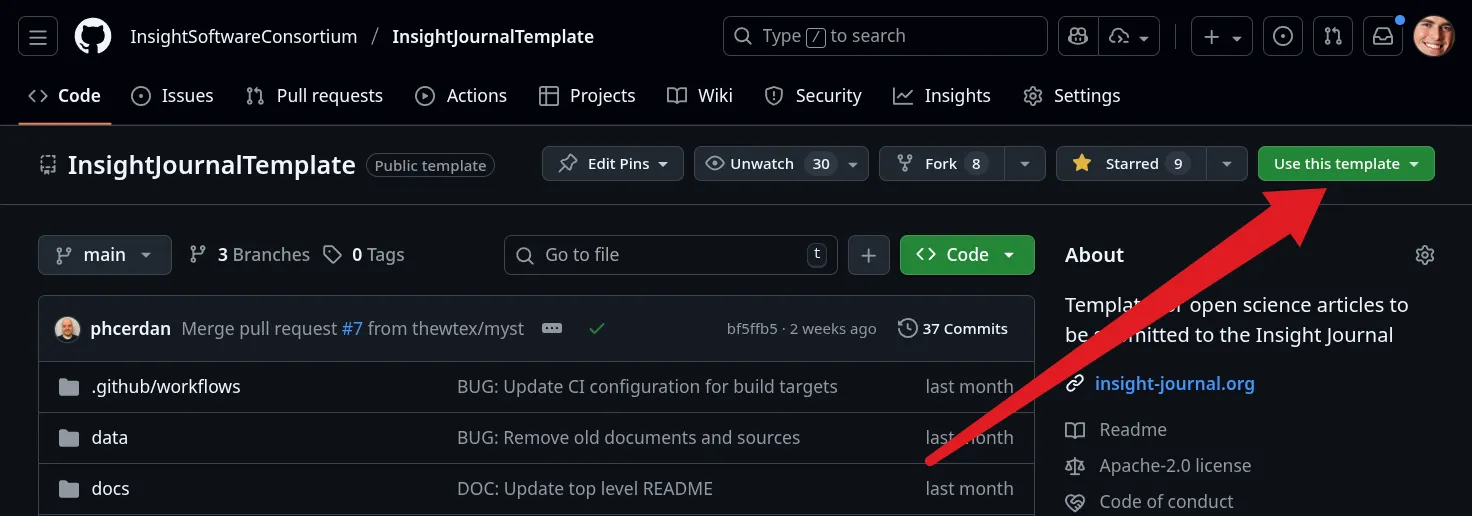
To create a new article repository, click the "Use this template" button on the GitHub page. This will create a new repository in your GitHub account that you can clone and edit locally. Follow the instructions in the README to set up your development environment and start writing.
Authorship and Attribution
All authors who have made substantial contributions to the work should be listed. The template supports multiple authors with institutional affiliations. Authorship includes:
- Substantial contributions to conception and design, or acquisition of data, or analysis and interpretation of data
- Drafting the article or revising it critically for important intellectual content
- Final approval of the version to be published
What to Include in Your Submission
Complete research objects for the Insight Journal should include:
- Manuscript: Your paper in MyST or LaTeX format
- Source Code: Complete, documented, buildable code
- Data: Input datasets and examples
- Parameters: Configuration files and settings
- Results: Output data and visualizations
- Build Instructions: pyproject.toml, CMakeLists.txt or equivalent
- Tests: Validation and verification tests
- Documentation: README files and usage instructions
Become a Reviewer
Peer review is essential to maintaining the quality and integrity of published research. The Insight Journal recognizes the value of this service through:
- Public Attribution: Your reviews are signed and become part of the permanent record
- ORCID Credit: Automatic entries in your ORCID profile for review work
- Reputation Building: Build your reputation through quality, constructive reviews
The Review Process
As a reviewer, you will:
- Receive invitations to review submissions that match your expertise
- Access the complete research object (manuscript, code, data)
- Evaluate whether the work is reproducible by running the provided code
- Assess claims made in the manuscript against actual results
- Provide constructive feedback through public comments
- Validate or request changes to claimed attestations
What Makes a Good Review
- Reproducibility Check: Did you successfully build and run the code?
- Results Verification: Do the provided data and code produce the claimed results?
- Methodological Soundness: Are the methods appropriate and well-described?
- Clarity: Is the manuscript clear and well-written?
- Completeness: Are all necessary materials included?
- Innovation: Does the work make a meaningful contribution?
Open Peer Review
The Insight Journal practices open peer review where:
- Reviewers' identities are known to authors
- Reviews are public and part of the permanent record
- Author-reviewer dialogue happens in the open
- The community can see the evolution of the work through review
This transparency increases accountability and trust while educating the broader community about quality standards.
Join the Community
Beyond submitting and reviewing, you can contribute to the Insight Journal by:
- Participating in community discussions
- Providing feedback on platform features and policies
- Helping maintain and improve the article template
- Spreading awareness of open science principles
- Supporting the development of ITK and related tools